Étiquette : science (Page 1 of 3)

arXiv : les chercheurs qui soumettent des articles genAI erronés seront suspendus un an

Affichage de l'image en full screen

“La plateforme pionnière de prépublication scientifique arXiv va suspendre pour un an tout chercheur qui aurait mis en ligne un article erroné et manifestement généré par IA.« Si un article contient des preuves irréfutables indiquant que les auteurs n’ont pas vérifié les résultats générés par un grand modèle de langage (LLM), cela signifie que nous ne pouvons avoir confiance en quoi que ce soit contenu dans cet article », expliquait dans un thread sur X jeudi dernier Thomas Dietterich, le responsable adjoint de la plateforme.
Il ajoutait que l’équipe avait décidé d’une suspension d’un an de la plateforme pour tout auteur ayant signé un tel article. Après cette année de suspension, la plateforme acceptera les articles signés par cet auteur s’ils ont déjà été acceptés par une revue ou une conférence qui aura déjà effectué le filtre de relecture par les pairs. Autant dire que l’intérêt de mettre en ligne sur arXiv deviendra quasiment inexistant pour ces personnes.« Notre code de conduite stipule qu’en apposant sa signature en tant qu’auteur d’un article, chaque auteur assume l’entière responsabilité de l’ensemble de son contenu, quelle que soit la manière dont celui-ci a été élaboré », justifie-t-il.”

Source : arXiv : les chercheurs qui soumettent des articles genAI erronés seront suspendus un an – Next

Nearly one-third of social media research has undisclosed ties to industry, preprint claims


Social Media + Zoom + TikTok

“The team then looked through information from OpenAlex—an open-access catalog of scientific papers—and industry announcements to check for ties between authors and social media companies during the period when the journals required disclosure. They found about half of all papers had some such tie, suggesting authors in 30% of all studies were not declaring potential conflicts of interest. For the subset of papers that revealed the identity of the editors and peer reviewers, the authors also examined whether they, too, had any conflicts of interest. Adding those who did to the analysis pushed up the proportion of papers that had some industry tie to 66%. Extrapolating to cases where the reviewers were anonymous, the researchers estimated that only one in five papers were likely to have remained fully independent of industry throughout the publication process.”

Source : Nearly one-third of social media research has undisclosed ties to industry, preprint claims | Science | AAAS

YouTube Bans Anti-Vaccine Misinformation

YouTube said it was banning the accounts of several prominent anti-vaccine activists from its platform, including Robert F. Kennedy Jr.’s.

“In a blog post, YouTube said it would remove videos claiming that vaccines do not reduce rates of transmission or contraction of disease, and content that includes misinformation on the makeup of the vaccines. Claims that approved vaccines cause autism, cancer or infertility, or that the vaccines contain trackers, will also be removed.
Prominent anti-vaccine activists have long been able to build huge audiences online, helped along by the algorithmic powers of social networks that prioritize videos and posts that are particularly successful at capturing people’s attention. A nonprofit, the Center for Countering Digital Hate, published research this year showing that a group of 12 people were responsible for sharing 65 percent of all anti-vaccine messaging on social media, calling the group the “Disinformation Dozen.” In July, the White House cited the research as it criticized tech companies for allowing misinformation about the coronavirus and vaccines to spread widely, sparking a tense back-and-forth between the administration and Facebook.”

Source : YouTube Bans Anti-Vaccine Misinformation – The New York Times

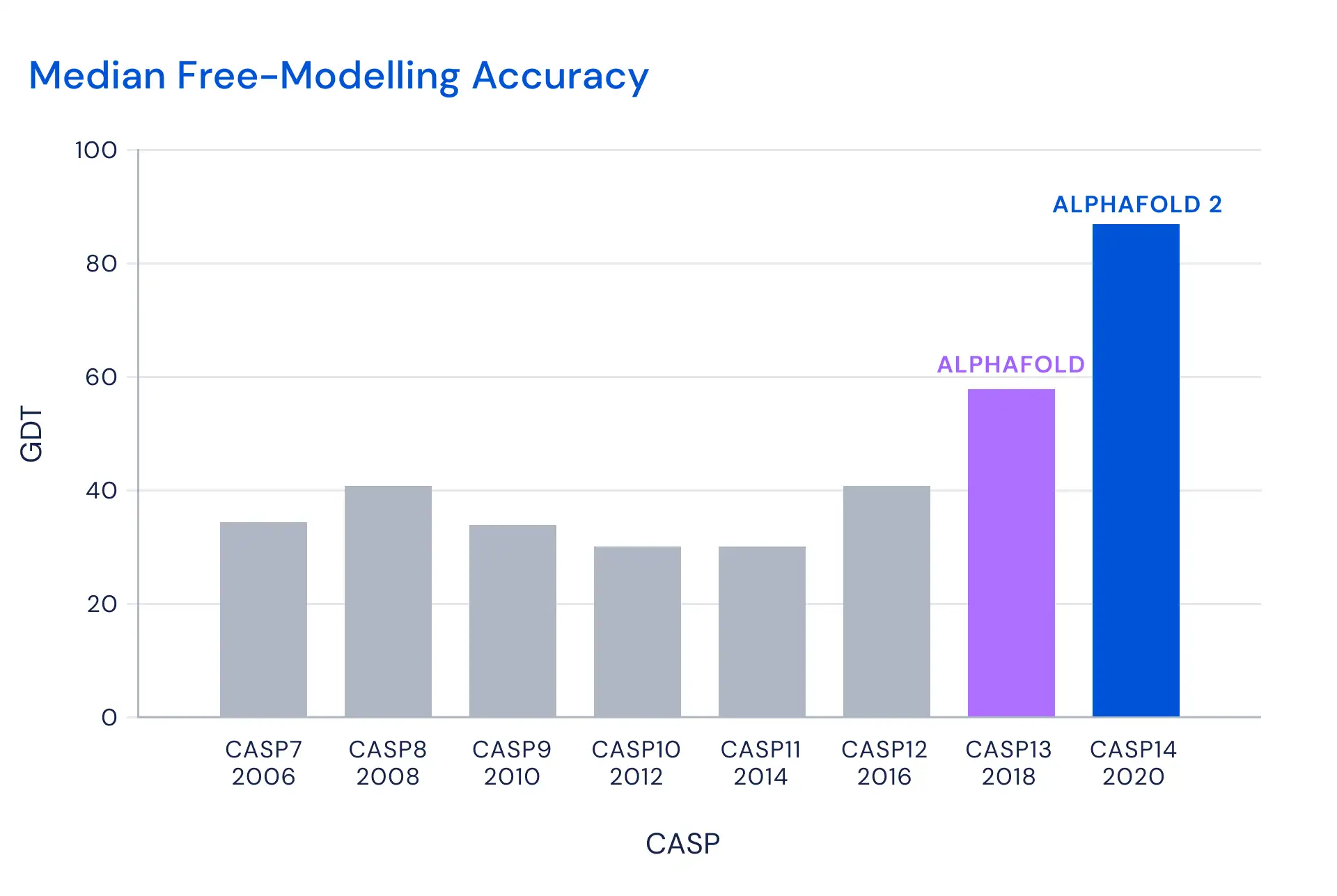
https://lh3.googleusercontent.com/KKbgSsS1qIoesiy2Ws_WDsDSyGhTZgP9W3qZr-xS5ElnafEu80joptKmc2hgz01a6j6yIj5cvCnqz8bBfXG8BND44ZKJ_kv7tTHQAA=w2048-rw-v1

“This computational work represents a stunning advance on the protein-folding problem, a 50-year-old grand challenge in biology. It has occurred decades before many people in the field would have predicted. It will be exciting to see the many ways in which it will fundamentally change biological research”.

Professor Venki Ramakrishnan – Nobel Laureate and President of the Royal Society

“We trained this system on publicly available data consisting of ~170,000 protein structures from the protein data bank together with large databases containing protein sequences of unknown structure. It uses approximately 16 TPUv3s (which is 128 TPUv3 cores or roughly equivalent to ~100-200 GPUs) run over a few weeks, a relatively modest amount of compute in the context of most large state-of-the-art models used in machine learning today.”

Source : AlphaFold: a solution to a 50-year-old grand challenge in biology | DeepMind

https://no-flux.beaude.net/wp-content/uploads/2020/02/d41586-019-03572-7_17405256.jpg

“A number of researchers have analysed various selection methods and suggested that incorporating randomness has advantages over the current system, such as reducing the bias that research routinely shows plagues grant-giving, and improving diversity among grantees1.”

Source : Science funders gamble on grant lotteries

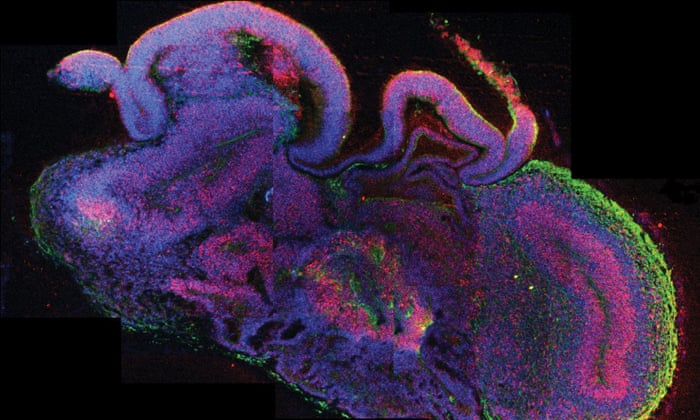
“On Monday, researchers will tell the world’s largest annual meeting of neuroscientists that some scientists working on organoids are “perilously close” to crossing the ethical line, while others may already have done so by creating sentient lumps of brain in the lab. “If there’s even a possibility of the organoid being sentient, we could be crossing that line,” said Elan Ohayon, the director of the Green Neuroscience Laboratory in San Diego, California. “We don’t want people doing research where there is potential for something to suffer.””

Source : Scientists ‘may have crossed ethical line’ in growing human brains | Science | The Guardian

“Interviews with 30 attendees revealed a pattern in the stories people told about how they came to be convinced that the Earth was not a large round rock spinning through space but a large flat disc doing much the same thing. Of the 30, all but one said they had not considered the Earth to be flat two years ago but changed their minds after watching videos promoting conspiracy theories on YouTube.”

Source : Study blames YouTube for rise in number of Flat Earthers | Science | The Guardian

« Older posts

© 2026 no-Flux

Theme by Anders NorenUp ↑