
The Internet companies’ data centers are locked down with full-time security and state-of-the-art surveillance, including heat sensors and iris scanners. But between the data centers — on Level 3’s fiber-optic cables that connected those massive computer farms — information was unencrypted and an easier target for government intercept efforts, according to three people with knowledge of Google’s and Yahoo’s systems who spoke on the condition of anonymity. It is impossible to say for certain how the N.S.A. managed to get Google and Yahoo’s data without the companies’ knowledge. But both companies, in response to concerns over those vulnerabilities, recently said they were now encrypting data that runs on the cables between their data centers. Microsoft is considering a similar move.
Auteur/autrice : noflux (Page 420 of 635)
The National Security Agency has been gathering records of online sexual activity and evidence of visits to pornographic websites as part of a proposed plan to harm the reputations of those whom the agency believes are radicalizing others through incendiary speeches, according to a top-secret NSA document.
« Want laptop value? Know what to look for ». (EXTENDED VERSION) (par ScroogledTruth)
(Source: https://www.youtube.com/)
Le droit à la vie privée à l’ère du numérique a fait l’objet d’un nouveau projet de résolution adopté aujourd’hui, par consensus, par la Troisième Commission. L’Assemblée générale affirmerait ainsi, pour la première fois, que « les droits dont les personnes jouissent hors ligne doivent également être protégés en ligne, y compris le droit à la vie privée ».
Jimmy Wales, the founder of Wikipedia, has called on Barack Obama to rein in the National Security Agency as he described the whistleblower Edward Snowden as “a hero” whom history will judge “very favourably”.
Les premiers à prendre conscience du problème, bien avant les révélations d’Edward Snowden, étaient les Pays-Bas, qui ont imposé un cloud national à leurs administrations dès 2011. En France, la question du cloud souverain a également été posée à la même époque, ce qui a donné naissance à deux consortiums, Cloudwatt (Orange/Thales), et Numergy (SFR/Bull).
En octobre, la presse californienne avait raconté comment le jeune milliardaire avait racheté trois villas contiguës à la sienne, à Palo Alto, histoire de ne pas être embêté par des voisins. Celui qui fait commerce de la vie privée des autres protège donc la sienne. On peut se demander si la tentative de rachat de Snapchat par Facebook ne relève pas du même réflexe.
The next social network will provide tools with which it will be possible to create endless variations – variations the original creators of the network could have never dreamt of. That’s where the magic is going to happen; where the masses will create perpetual diversity and disruption, effectively avoiding Facebook’s fate. After all, how can you disrupt a network that is disrupting itself?
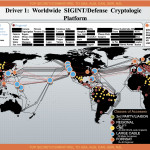
« The information published this weekend is another revelation courtesy of leaker Edward Snowden. The 50,000-figure comes from a 2012 presentation slide explaining how the NSA acquired information worldwide. It described an initiative called « Computer Network Exploitation » (CNE), which NRC reports as « the secret infiltration of computer systems achieved by installing malware. » » (via Report: NSA-planted malware spans five continents, 50,000 computer networks | Ars Technica)
Internet et les réseaux sociaux encouragent de plus en plus les gens à s’organiser, à agir et faire éclater au grand jour des méfaits commis aux quatre coins de la planète. Cela menace certains gouvernements et entraîne une augmentation de la surveillance et de la censure, qui menace à son tour l’avenir de la démocratie.