Étiquette : manipulation (Page 12 of 17)

Uber Ripley

«The Uber HQ team overseeing Ripley could remotely change passwords and otherwise lock up data on company-owned smartphones, laptops, and desktops as well as shut down the devices. This routine was initially called the unexpected visitor protocol. Employees aware of its existence eventually took to calling it Ripley, after Sigourney Weaver’s flamethrower-wielding hero in the Alien movies. The nickname was inspired by a Ripley line in Aliens, after the acid-blooded extraterrestrials easily best a squad of ground troops. ‘Nuke the entire site from orbit. It’s the only way to be sure.’»

Source : Uber’s Secret Tool for Keeping the Cops in the Dark – Bloomberg

«We present a method to create universal, robust, targeted adversarial image patches in the real world. The patches are universal because they can be used to attack any scene, robust because they work under a wide variety of transformations, and targeted because they can cause a classifier to output any target class. These adversarial patches can be printed, added to any scene, photographed, and presented to image classifiers; even when the patches are small, they cause the classifiers to ignore the other items in the scene and report a chosen target class».

Source : Adversarial Patch – Research Article | DeepAI

Uber

«These Uber security employees went to great lengths to hide their surveillance activities from the authorities, Jacobs says. They used computers not purchased by Uber that ran on Mi-Fi devices, so the traffic wouldn’t appear on Uber’s network. They also used virtual public networks and “non-attributable architecture of contracted Amazon Web Services” to further conceal their efforts, Jacobs alleges. Who were they surveilling? Jacobs says SSG’s targets included “politicians, regulators, law enforcement, taxi organizations, and labor unions in, at a minimum, the US.”

Source : Uber allegedly hacked rivals, surveilled politicians, and impersonated protestors – The Verge

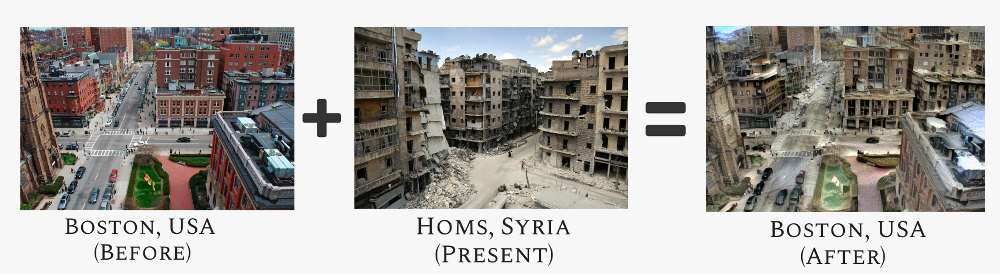
Deep Empathy Boston+Syria

«Can we use AI to increase empathy for victims of far-away disasters by making our homes appear similar to the homes of victims?»

Source : Deep Empathy

«Unsupervised image-to-image translation aims at learning a joint distribution of images in different domains by using images from the marginal distributions in individual domains. Since there exists an infinite set of joint distributions that can arrive the given marginal distributions, one could infer nothing about the joint distribution from the marginal distributions without additional assumptions».

Source : Unsupervised Image-to-Image Translation Networks | Research

«Il y a des brouteurs stars, qui sont les idoles de plusieurs d’entre nous, comme ­Commissaire 5500, qui fait le buzz depuis son retour de prison, Président Extractor, ­Président ­Morisson… Comme on dit ici : “On fait tous le même boulot, mais on n’a pas tous le même salaire.” Le djai [l’argent] dépend du poids des clients. Récemment, j’ai gagné 38 000 euros en une seule opération. C’est pour ça que je préfère maintenant travailler chez moi, parce que, quand on fait ça depuis un cybercafé, comme on partage les ordinateurs, on peut facilement se faire voler ses Blancs par d’autres brouteurs. Il y a trop de malhonnêtes !»

Source : Escroqueries sur le Web : « Je ne rêvais, mangeais et buvais que pour le broutage »

«L’histoire dépasse les fake news habituelles pour se rapprocher de la désinformation et du sabotage journalistique à visée politique.« L’essence de ce complot a été de nous tromper et de nous ridiculiser », écrit le directeur de la rédaction du Post, Marty Baron. Dans un rare exercice de métajournalisme, ses journalistes ont scrupuleusement relaté les détails de ce « complot », de la première rencontre jusqu’aux doutes et à la confirmation qu’ils étaient bien en train d’être piégés par une lanceuse d’alerte qui n’en était pas une».

Source : Faux témoignages, caméras cachées : comment le « Washington Post » a géré une campagne de déstabilisation

«We need to sort of give you a little dopamine hit every once in a while, because someone liked or commented on a photo or a post or whatever. And that’s going to get you to contribute more content, and that’s going to get you … more likes and comments.
It’s a social-validation feedback loop … exactly the kind of thing that a hacker like myself would come up with, because you’re exploiting a vulnerability in human psychology.
The inventors, creators — it’s me, it’s Mark [Zuckerberg], it’s Kevin Systrom on Instagram, it’s all of these people — understood this consciously. And we did it anyway.»

Source : Sean Parker unloads on Facebook « exploiting » human weakness

« Older posts Newer posts »

© 2026 no-Flux

Theme by Anders NorenUp ↑