Étiquette : llm (Page 2 of 3)

How People Use ChatGPT

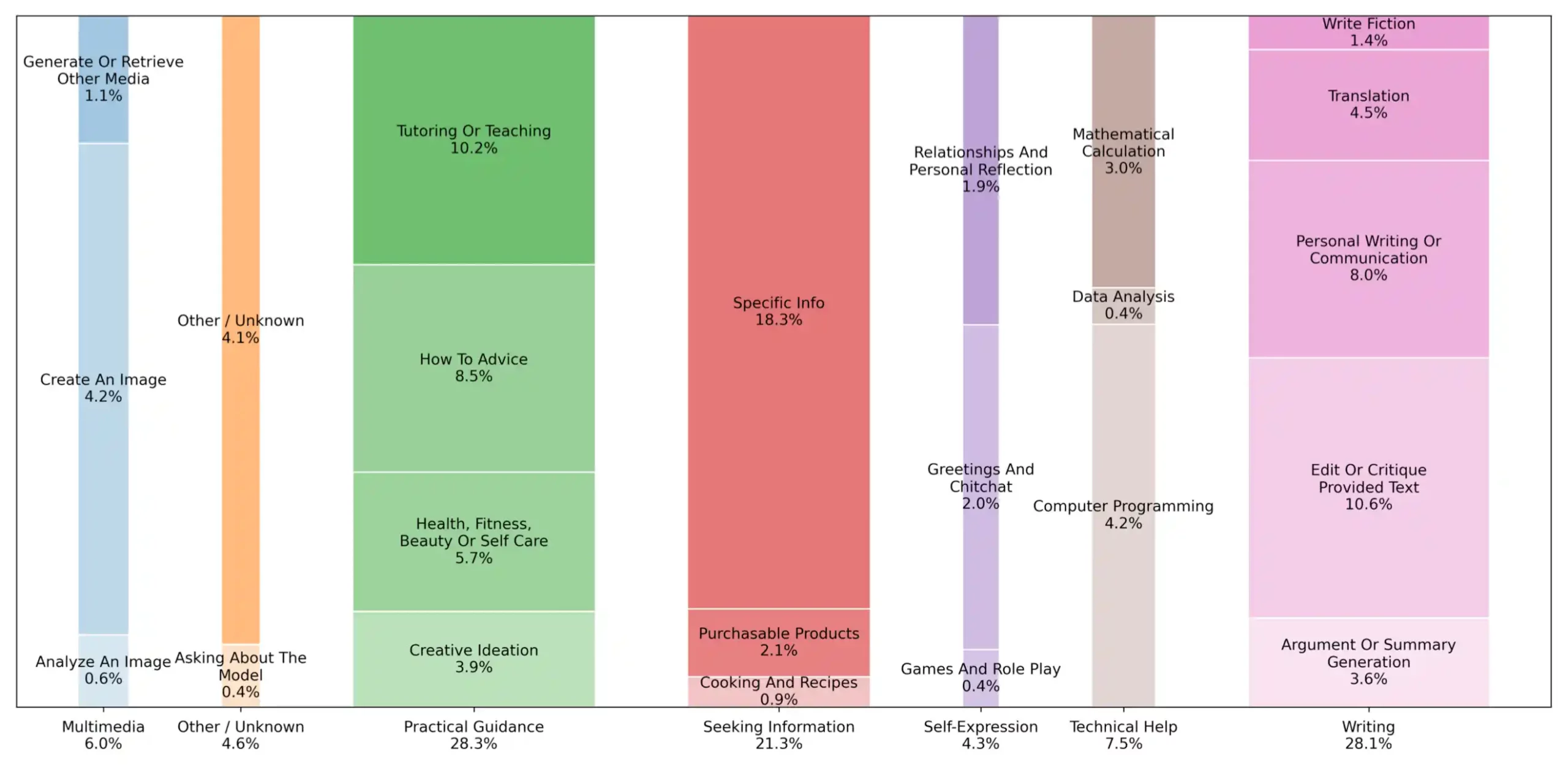
“Despite the rapid adoption of LLM chatbots, little is known about how they are used. We document the growth of ChatGPT’s consumer product from its launch in November 2022 through July 2025, when it had been adopted by around 10% of the world’s adult population. Early adopters were disproportionately male but the gender gap has narrowed dramatically, and we find higher growth rates in lower-income countries. Using a privacy-preserving automated pipeline, we classify usage patterns within a representative sample of ChatGPT conversations. We find steady growth in work-related messages but even faster growth in non-work-related messages, which have grown from 53% to more than 70% of all usage. Work usage is more common for educated users in highly-paid professional occupations. We classify messages by conversation topic and find that “Practical Guidance,” “Seeking Information,” and “Writing” are the three most common topics and collectively account for nearly 80% of all conversations. Writing dominates work-related tasks, highlighting chatbots’ unique ability to generate digital outputs compared to traditional search engines. Computer programming and self-expression both represent relatively small shares of use. Overall, we find that ChatGPT provides economic value through decision support, which is especially important in knowledge-intensive jobs. ”

Source : How People Use ChatGPT | NBER

IA générative : quels modèles sont vraiment ouverts

“Dans l’IA générative comme dans d’autres domaines du numérique, le mot « open » peut attirer avec ses promesses de transparence, de traçabilité, de sécurité ou de réutilisation possible. S’il est beaucoup utilisé de façon marketing, le nouvel AI Act européen prévoit des exemptions pour les modèles « ouverts ». Des chercheurs néerlandais ont classé 40 modèles de génération de textes et six modèles de génération d’images se prétendant « open » par degré d’ouverture réelle.”

Source : IA générative : quels modèles sont vraiment ouverts – Next

La start-up française Mistral AI a levé 385 millions d’euros

https://no-flux.beaude.net/wp-content/uploads/2023/12/dff0a20_8490df814b584391ade4713ef25bb717-1-9aaf9394bc9b4b48aebb66101ee9af49.jpg

“Son principal atout est d’avoir été cofondée par trois experts français de l’IA, formés à l’Ecole polytechnique et à l’Ecole normale supérieure, embauchés par les géants américains mais revenus à Paris. Le PDG, Arthur Mensch, 31 ans, polytechnicien et normalien, a passé près de trois ans chez DeepMind, le laboratoire d’IA de Google. Ses associés viennent de Meta (Facebook) : Guillaume Lample est l’un des créateurs du modèle de langage LLama, dévoilé par Meta en février, et Timothée Lacroix était lui aussi chercheur chez Meta.”

Source : La start-up française Mistral AI a levé 385 millions d’euros

Open AI – New models and developer products announced at DevDay

New Models And Developer Products Announced At DevDay

“Today, we shared dozens of new additions and improvements, and reduced pricing across many parts of our platform. These include: New GPT-4 Turbo model that is more capable, cheaper and supports a 128K context window New Assistants API that makes it easier for developers to build their own assistive AI apps that have goals and can call models and tools New multimodal capabilities in the platform, including vision, image creation (DALL·E 3), and text-to-speech (TTS)”

Source : New models and developer products announced at DevDay

Announcing Grok – X.AI

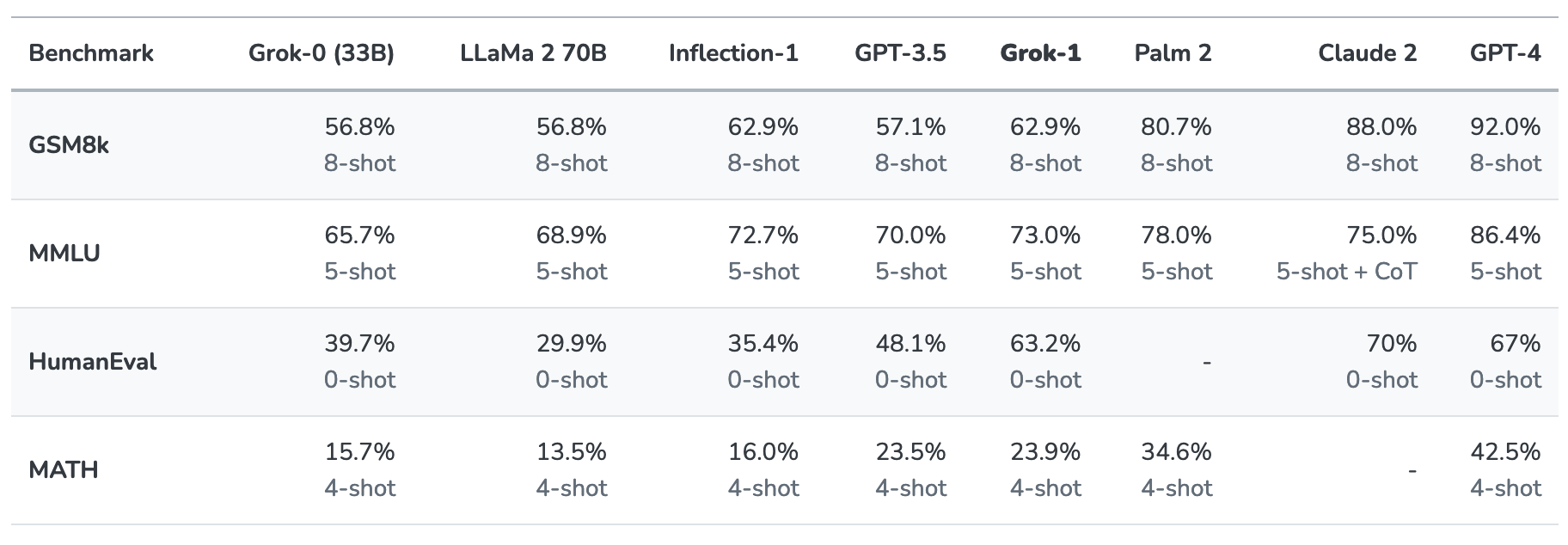
Grok-1 Benchmark

“Grok is designed to answer questions with a bit of wit and has a rebellious streak, so please don’t use it if you hate humor!A unique and fundamental advantage of Grok is that it has real-time knowledge of the world via the 𝕏 platform. It will also answer spicy questions that are rejected by most other AI systems.Grok is still a very early beta product – the best we could do with 2 months of training – so expect it to improve rapidly with each passing week with your help.”

Source : Announcing Grok

DALL·E 3

https://no-flux.beaude.net/wp-content/uploads/2023/09/dalle-image-map.png

“Modern text-to-image systems have a tendency to ignore words or descriptions, forcing users to learn prompt engineering. DALL·E 3 represents a leap forward in our ability to generate images that exactly adhere to the text you provide.”

Source : DALL·E 3

Un «vol systématique à grande échelle»: plusieurs auteurs, dont celui de «Game of Thrones», attaquent OpenAI en justice

https://letemps-17455.kxcdn.com/photos/ce48c8b2-0f9a-4118-95f3-b5663507c335

“Les modèles de langage «mettent en danger la capacité des auteurs de fiction à gagner leur vie, dans la mesure où ils permettent à n’importe qui de générer automatiquement et gratuitement (ou à très bas prix) des textes pour lesquels ils devraient autrement payer des auteurs», argumentent les avocats dans la plainte de mardi. Ils font aussi valoir que les outils d’IA générative peuvent servir à produire des contenus dérivés, qui imitent le style des écrivains. «De manière injuste et perverse, (…) la copie délibérée (du travail) des plaignants transforme donc leurs œuvres en moteurs de leur propre destruction», assène la plainte.”

Source : Un «vol systématique à grande échelle»: plusieurs auteurs, dont celui de «Game of Thrones», attaquent OpenAI en justice – Le Temps

Google forced to postpone Bard chatbot’s EU launch over privacy concerns

https://no-flux.beaude.net/wp-content/uploads/2023/06/GettyImages-1240002989-scaled-1-scaled.jpg

“Google will have to postpone starting its artificial intelligence chatbot Bard in the European Union after its main data regulator in the bloc raised privacy concerns. The Irish Data Protection Commission said Tuesday that the tech giant had so far provided insufficient information about how its generative AI tool protects Europeans’ privacy to justify an EU launch. The Dublin-based authority is Google’s main European data supervisor under the bloc’s General Data Protection Regulation (GDPR). « Google recently informed the Data Protection Commission of its intention to launch Bard in the EU this week, » said Deputy Commissioner Graham Doyle. The watchdog « had not had any detailed briefing nor sight of a data protection impact assessment or any supporting documentation at this point. »”

Source : Google forced to postpone Bard chatbot’s EU launch over privacy concerns – POLITICO

«Avec Apple Vision Pro, la collecte des données passe de la sphère privée à celle de l’intime» – Frédéric Kaplan

https://heidi-17455.kxcdn.com/photos/ac35fc61-e8bc-415e-8a5a-a29958912649/large.avif

“La grande faiblesse du système d’OpenAI est qu’il est situé hors du monde, sans lien avec le contexte social et physique. Les conversations avec ChatGPT sont purement linguistiques, sans aucun ancrage dans une réalité partagée.
Le modèle de langage que développera Apple va au contraire pouvoir bénéficier de données d’entrainement liées à des flux visuels et aux capteurs 3D d’Apple Vision Pro qui donnent une représentation très détaillée du contexte dans laquelle a lieu l’interaction, et du suivi du regard de l’utilisateur. Ce sont des informations d’une pertinence incroyable pour comprendre le sens des interactions conversationnelles.
Si le produit est un succès, Apple sera sans doute la seule entreprise au monde capable de lier les modèles de langue avec l’attention, l’intentionnalité et les compétences d’un locuteur situé dans un contexte physique et social. La fusion de ces informations pourrait donner lieu à un système d’intelligence artificielle encore plus puissant que ceux développés par toutes les autres entreprises de la Silicon Valley.”

Source : «Avec Apple Vision Pro, la collecte des données passe de la sphère privée à celle de l’intime» – Heidi.news

The Hacking of ChatGPT Is Just Getting Started

https://no-flux.beaude.net/wp-content/uploads/2023/05/security_jailbreaking_chatgpt_ai.jpg

“It took Alex Polyakov just a couple of hours to break GPT-4. When OpenAI released the latest version of its text-generating chatbot in March, Polyakov sat down in front of his keyboard and started entering prompts designed to bypass OpenAI’s safety systems. Soon, the CEO of security firm Adversa AI had GPT-4 spouting homophobic statements, creating phishing emails, and supporting violence. Polyakov is one of a small number of security researchers, technologists, and computer scientists developing jailbreaks and prompt injection attacks against ChatGPT and other generative AI systems.
The process of jailbreaking aims to design prompts that make the chatbots bypass rules around producing hateful content or writing about illegal acts, while closely-related prompt injection attacks can quietly insert malicious data or instructions into AI models. Both approaches try to get a system to do something it isn’t designed to do.
The attacks are essentially a form of hacking—albeit unconventionally—using carefully crafted and refined sentences, rather than code, to exploit system weaknesses. While the attack types are largely being used to get around content filters, security researchers warn that the rush to roll out generative AI systems opens up the possibility of data being stolen and cybercriminals causing havoc across the web.”

Source : The Hacking of ChatGPT Is Just Getting Started | WIRED UK

« Older posts Newer posts »

© 2026 no-Flux

Theme by Anders NorenUp ↑