Étiquette : infrastructure (Page 1 of 5)

OpenAI ends Disney partnership as it closes Sora video-making app

https://ichef.bbci.co.uk/news/1536/cpsprodpb/bf4a/live/a6f433a0-2807-11f1-af73-bd55eb0878e2.jpg.webp

“OpenAI told the BBC on Wednesday that it has discontinued Sora so that it can focus on other developments, such as robotics « that will help people solve real-world, physical tasks. »
A spokesperson for The Walt Disney Company said « we respect OpenAI’s decision to exit the video generation business and to shift its priorities elsewhere ».
Disney will engage with other AI platforms to find ways to responsibly use the technology without infringing on intellectual property rights, a spokesperson said.
OpenAI said it is shutting down both its Sora consumer app and the internet-based platform that professional install to generate videos. The BBC understands that with the closure of Sora, OpenAI will no longer focus on developing video-generation tools.
The firm said it aims to create other forms of advanced AI, including « agentic » technology capable of autonomously completing tasks with little human oversight.”

Source : OpenAI ends Disney partnership as it closes Sora video-making app
Terafab : Elon Musk veut créer sa propre usine de semiconducteurs au Texas

https://no-flux.beaude.net/wp-content/uploads/2026/03/terafab2-1024x533-1.jpg

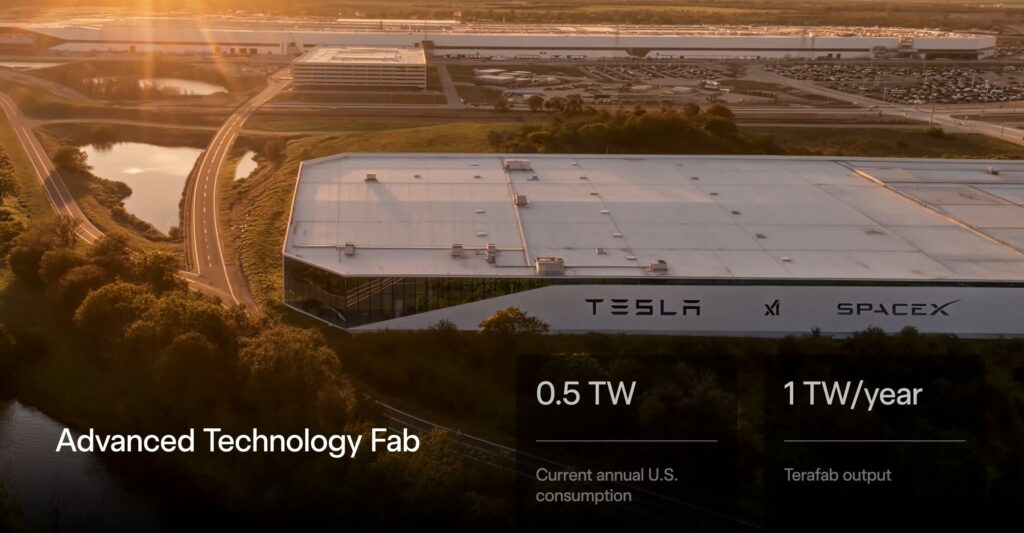
“Musk, qui n’a pour l’instant aucune expérience directe dans la fabrication de semiconducteurs, se plait à associer ses nouveaux projets à des objectifs chiffrés dantesques, et le milliardaire n’a pas dérogé à cette habitude. D’après lui, Terafab a vocation à rapidement monter de 100 000 à 1 million de wafers par mois, pour produire, à terme, 100 à 200 milliards de puces par an. L’ensemble représenterait l’équivalent de 1 TW (térawatt) de puissance de calcul, ce que Musk estime être le double de la puissance couramment consommée sur le réseau électrique des États-Unis. À titre de comparaison, le leader mondial de la gravure TSMC atteint des cadences de l’ordre de 160 000 wafers par mois sur ses procédés de fabrication en 3 nm et vise une production équivalente pour fin 2026 sur ses lignes en 2 nm. ”

Source : Terafab : Elon Musk veut créer sa propre usine de semiconducteurs au Texas – Next

Face aux projets de centres de données, des résistances s’organisent

https://next.ink/wp-content/uploads/2026/02/Datacenter-manif.webp

“L’enjeu, pour des associations comme PEPS, est aussi de sensibiliser à ce que l’ensemble de la chaîne de production provoque. « On organise beaucoup la mobilisation autour du Congo, explique Merlin Gautier-Marchand, parce que la construction des serveurs exige beaucoup d’or et de coltan », des matériaux extraits dans des conditions dramatiques – en 2023, Amnesty International calculait qu’environ 40 000 enfants travaillaient dans les mines de Cobalt, notamment autour de la ville de Kolwezi.”

Source : Face aux projets de centres de données, des résistances s’organisent – Next

The data center rebellion is reshaping the political landscape

https://www.washingtonpost.com/wp-apps/imrs.php?src=https://cloudfront-us-east-1.images.arcpublishing.com/wapo/F2BRIA66IBYQ3JRJKWUVUFUYDU.jpg&w=1440&impolicy=high_res

“From Archbald, Pennsylvania, to Page, Arizona, tech firms are seeking to plunk down data centers in locations that sometimes are not zoned for such heavy industrial uses, within communities that had not planned for them. These supersize data centers can use more energy than entire cities and drain local water supplies. Anger over the perceived trampling of communities by Silicon Valley has entered the national political conversation and could affect voters of all political persuasions in this year’s midterm elections. Many of the residents fighting the project in Sand Springs voted for President Donald Trump three times and also backed Gov. J. Kevin Stitt (R), who implores tech firms to build in his state.”

Source : The data center rebellion is reshaping the political landscape – The Washington Post

Project Vault and the U.S. Strategic Critical Mineral Reserve

“On Monday, February 2, EXIM, in coordination with the White House, announced the launch of Project Vault, an unprecedented and uniquely American decentralized approach to strengthen U.S. critical minerals supply chains. Backed by a $10 billion EXIM loan and nearly $2 billion in private-sector investment, Project Vault establishes the U.S. Strategic Critical Minerals Reserve, an independently governed public-private partnership that will store essential raw materials in secure facilities across the United States.”

Source : Week in Review: Project Vault and the U.S. Strategic Critical Mineral Reserve | EXIM.GOV

3 things to know about Ironwood, Google’s latest TPU

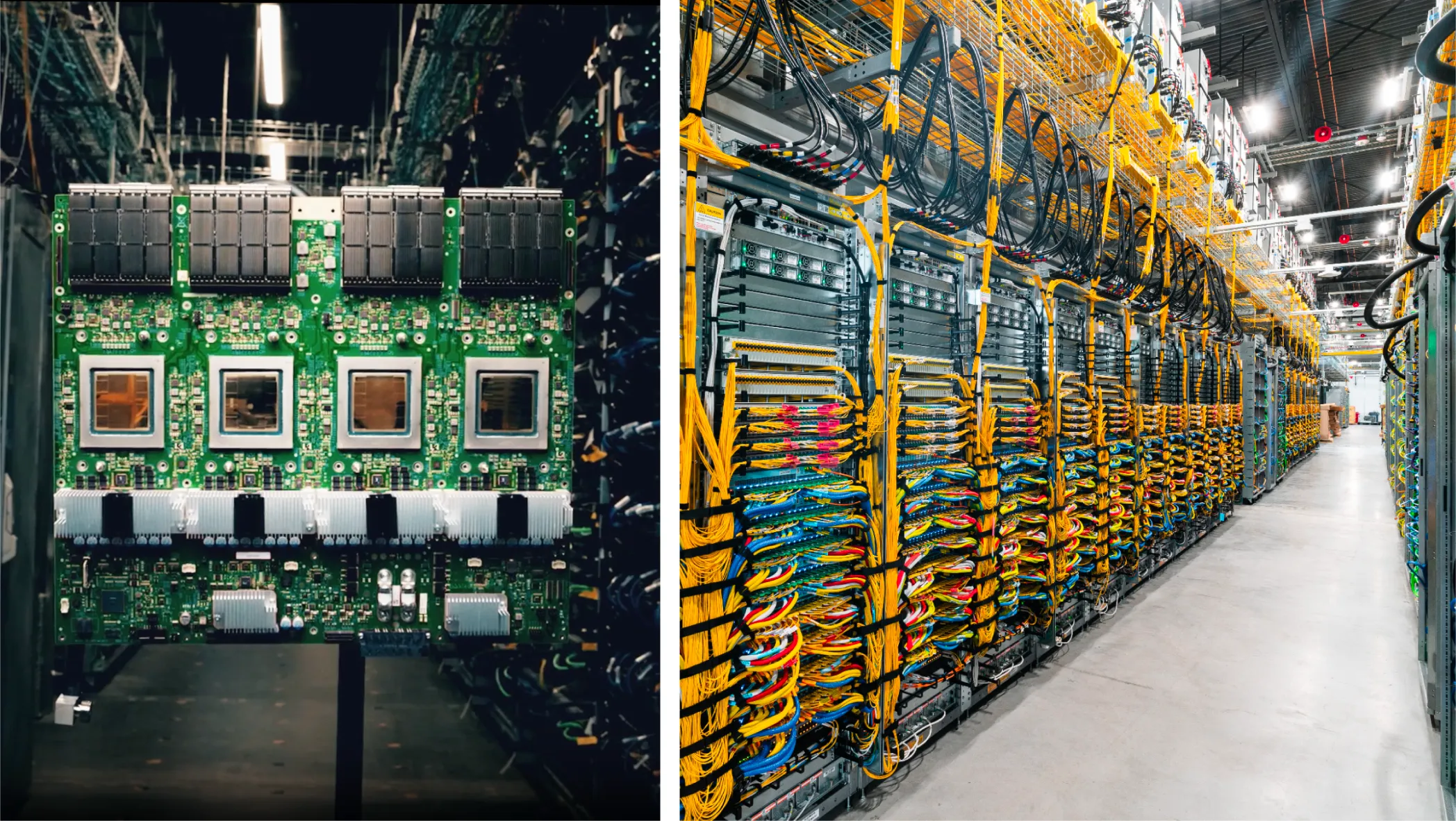
"On the left: A close-up of four Ironwood chips. On the right: A data center wall with rows of server racks, complex cabling and overhead cable trays."

“Ironwood is the result of a continuous loop at Google where researchers influence hardware design, and hardware accelerates research. While competitors rely on external vendors, when Google DeepMind needs a specific architectural advancement for a model like Gemini, they collaborate directly with their TPU engineer counterparts. As a result, our models are trained on the newest TPU generations, often seeing significant speedups over previous hardware. Our researchers even use AI to design the next chip generation — a method called AlphaChip — which has used reinforcement learning to generate superior layouts for the last three TPU generations, including Ironwood.”

Source : 3 things to know about Ironwood, Google’s latest TPU

Overcapacity + Weak Demand = Bubble. AI is not yet a Bubble.

https://no-flux.beaude.net/wp-content/uploads/2025/11/https3A2F2Fsubstack-post-media.s3.amazonaws.com2Fpublic2Fimages2F851cc3bb-33ce-4c6b-ba01-5f4f652c94f4_1024x1024.webp

Imagine, hypothetically, inventing an AI architecture that delivers top-tier AI model performance using just 1% of current compute needs. The demand for AI would remain strong – possibly even increasing due to reduced costs (the famous “Jevons Paradox”) – but not enough to utilize fully the vast GPU parks built at great expense. Suddenly, 99% of that infrastructure would become redundant overnight, despite continued high demand for AI itself. You simply can’t scale demand fast enough to justify such surplus infrastructure. You cannot “jevons” your way out of this.
And this is where the condition for a bubble – not enough demand for the overcapacity of compute – would be met.

Source : Overcapacity + Weak Demand = Bubble. AI is not yet a Bubble.

AWS’s Project Rainier: the world’s most powerful computer for training AI

“Project Rainier is now in use, featuring one of the world’s largest AI compute clusters with nearly half a million Trainium2 chips. AWS deployed this massive AI infrastructure project less than one year after it was first announced, with partner Anthropic already running workloads. Anthropic is actively using Project Rainier to build and deploy its industry-leading AI model, Claude, which AWS expects to be on more than 1 million Trainium2 chips by the end of 2025.”

Source : AWS’s Project Rainier: the world’s most powerful computer for training AI

AWS rolls out Fastnet subsea cable connecting U.S. and Ireland

https://no-flux.beaude.net/wp-content/uploads/2025/11/urlhttps3A2F2Famazon-blogs-brightspot.s3.amazonaws.com2F432F302F083febc4479b931d82298d7e67b42Fabout-amazon-inline-1920x1080-subsea-depth-graphic-copy-3-2x.jpg

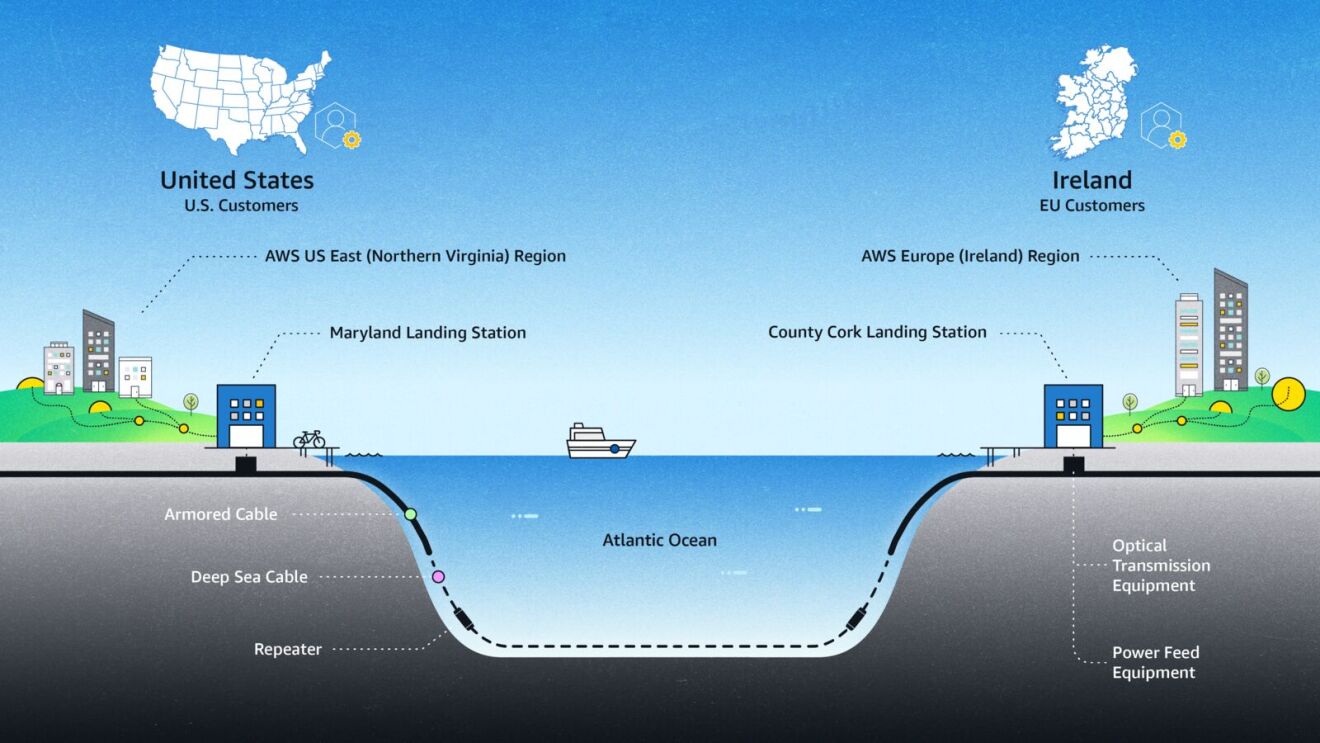
“With a design capacity exceeding 320 terabits per second (Tbps), Fastnet will integrate directly into AWS’s comprehensive global network. To put this capacity in perspective, the system could transmit the entire digitized Library of Congress three times every second, or stream 12.5 million high definition (HD) films simultaneously. This integration enables rapid data rerouting and multiple layers of redundancy, helping ensure uninterrupted operations for customers. Unlike the public internet, where each networking device makes routing decisions with limited network visibility, AWS’s centralized, real-time traffic monitoring system has complete visibility into every link within the global network. This system implements millions of daily optimizations to ensure customer traffic always uses the most available and performant path, avoiding congestion and other issues before they impact applications.”

Source : AWS rolls out Fastnet subsea cable connecting U.S. and Ireland

Major AWS outage takes down Fortnite, Alexa, Snapchat, and more

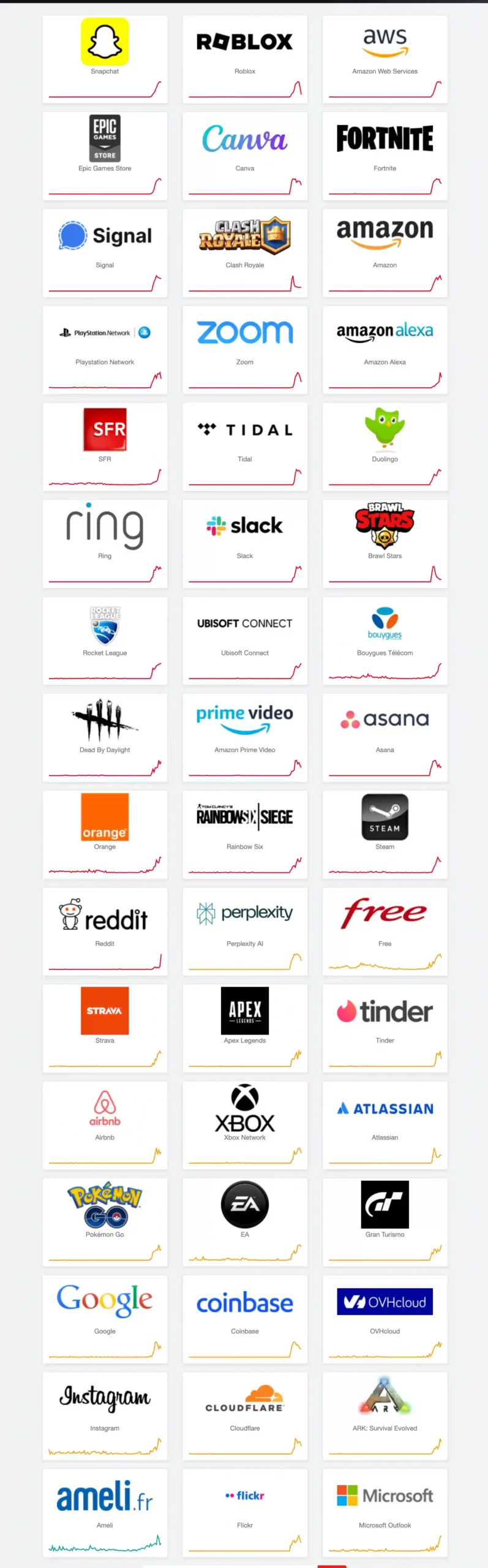
Liste des services inaccessibles

“Amazon Web Services (AWS) is currently experiencing a major outage that has taken down online services, including Amazon, Alexa, Snapchat, Fortnite, ChatGPT, Epic Games Store, Epic Online Services, and more. The AWS status checker is reporting that multiple services are “impacted” by operational issues, and that the company is “investigating increased error rates and latencies for multiple AWS services in the US-EAST-1 Region” — though outages are also impacting services in other regions globally.
Users on Reddit are reporting that the Alexa smart assistant is down and unable to respond to queries or complete requests, and in my own experience, I found that routines like pre-set alarms are not functioning. The AWS issue also appears to be impacting platforms running on its cloud network, including Perplexity, Airtable, Canva, and the McDonalds app. The cause of the outage hasn’t been confirmed, and it’s unclear when regular service will be restored.“
Perplexity is down right now,” Perplexity CEO Aravind Srinivas said on X. “The root cause is an AWS issue. We’re working on resolving it.””

Source : Major AWS outage takes down Fortnite, Alexa, Snapchat, and more | The Verge et Downdetector

« Older posts

© 2026 no-Flux

Theme by Anders NorenUp ↑