Étiquette : infrastructure (Page 1 of 4)

3 things to know about Ironwood, Google’s latest TPU

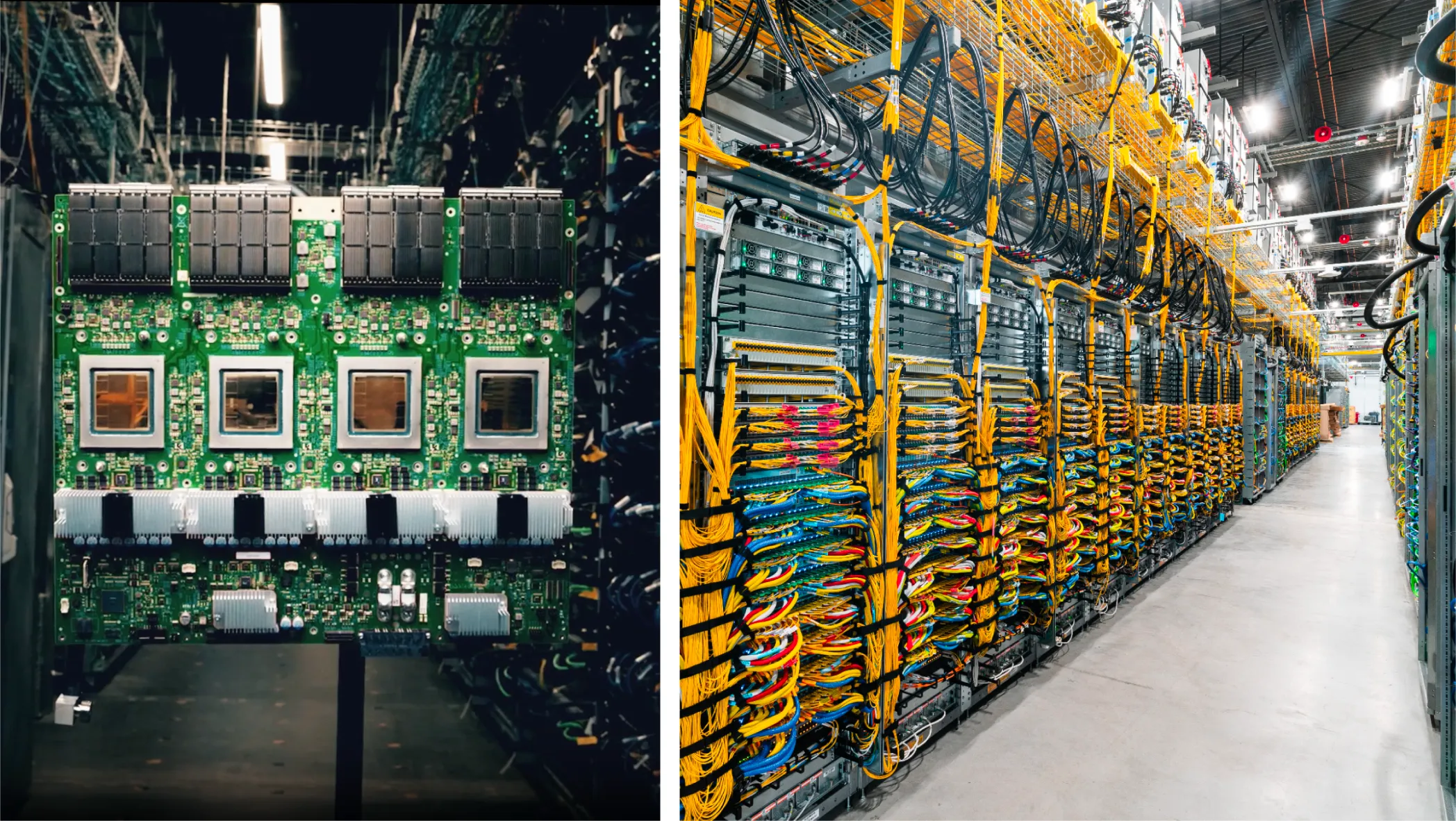
"On the left: A close-up of four Ironwood chips. On the right: A data center wall with rows of server racks, complex cabling and overhead cable trays."

“Ironwood is the result of a continuous loop at Google where researchers influence hardware design, and hardware accelerates research. While competitors rely on external vendors, when Google DeepMind needs a specific architectural advancement for a model like Gemini, they collaborate directly with their TPU engineer counterparts. As a result, our models are trained on the newest TPU generations, often seeing significant speedups over previous hardware. Our researchers even use AI to design the next chip generation — a method called AlphaChip — which has used reinforcement learning to generate superior layouts for the last three TPU generations, including Ironwood.”

Source : 3 things to know about Ironwood, Google’s latest TPU

Overcapacity + Weak Demand = Bubble. AI is not yet a Bubble.

https://no-flux.beaude.net/wp-content/uploads/2025/11/https3A2F2Fsubstack-post-media.s3.amazonaws.com2Fpublic2Fimages2F851cc3bb-33ce-4c6b-ba01-5f4f652c94f4_1024x1024.webp

Imagine, hypothetically, inventing an AI architecture that delivers top-tier AI model performance using just 1% of current compute needs. The demand for AI would remain strong – possibly even increasing due to reduced costs (the famous “Jevons Paradox”) – but not enough to utilize fully the vast GPU parks built at great expense. Suddenly, 99% of that infrastructure would become redundant overnight, despite continued high demand for AI itself. You simply can’t scale demand fast enough to justify such surplus infrastructure. You cannot “jevons” your way out of this.
And this is where the condition for a bubble – not enough demand for the overcapacity of compute – would be met.

Source : Overcapacity + Weak Demand = Bubble. AI is not yet a Bubble.

AWS’s Project Rainier: the world’s most powerful computer for training AI

“Project Rainier is now in use, featuring one of the world’s largest AI compute clusters with nearly half a million Trainium2 chips. AWS deployed this massive AI infrastructure project less than one year after it was first announced, with partner Anthropic already running workloads. Anthropic is actively using Project Rainier to build and deploy its industry-leading AI model, Claude, which AWS expects to be on more than 1 million Trainium2 chips by the end of 2025.”

Source : AWS’s Project Rainier: the world’s most powerful computer for training AI

AWS rolls out Fastnet subsea cable connecting U.S. and Ireland

https://no-flux.beaude.net/wp-content/uploads/2025/11/urlhttps3A2F2Famazon-blogs-brightspot.s3.amazonaws.com2F432F302F083febc4479b931d82298d7e67b42Fabout-amazon-inline-1920x1080-subsea-depth-graphic-copy-3-2x.jpg

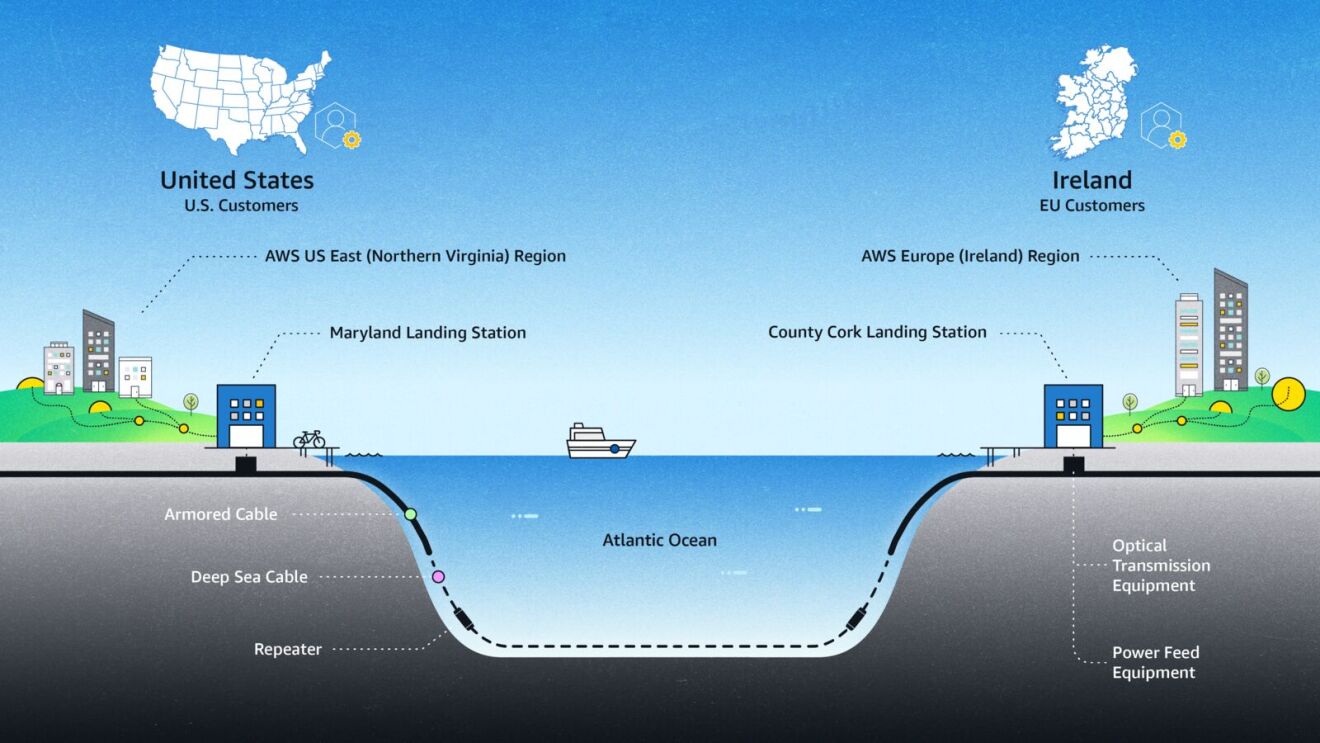
“With a design capacity exceeding 320 terabits per second (Tbps), Fastnet will integrate directly into AWS’s comprehensive global network. To put this capacity in perspective, the system could transmit the entire digitized Library of Congress three times every second, or stream 12.5 million high definition (HD) films simultaneously. This integration enables rapid data rerouting and multiple layers of redundancy, helping ensure uninterrupted operations for customers. Unlike the public internet, where each networking device makes routing decisions with limited network visibility, AWS’s centralized, real-time traffic monitoring system has complete visibility into every link within the global network. This system implements millions of daily optimizations to ensure customer traffic always uses the most available and performant path, avoiding congestion and other issues before they impact applications.”

Source : AWS rolls out Fastnet subsea cable connecting U.S. and Ireland

Major AWS outage takes down Fortnite, Alexa, Snapchat, and more

Liste des services inaccessibles

“Amazon Web Services (AWS) is currently experiencing a major outage that has taken down online services, including Amazon, Alexa, Snapchat, Fortnite, ChatGPT, Epic Games Store, Epic Online Services, and more. The AWS status checker is reporting that multiple services are “impacted” by operational issues, and that the company is “investigating increased error rates and latencies for multiple AWS services in the US-EAST-1 Region” — though outages are also impacting services in other regions globally.
Users on Reddit are reporting that the Alexa smart assistant is down and unable to respond to queries or complete requests, and in my own experience, I found that routines like pre-set alarms are not functioning. The AWS issue also appears to be impacting platforms running on its cloud network, including Perplexity, Airtable, Canva, and the McDonalds app. The cause of the outage hasn’t been confirmed, and it’s unclear when regular service will be restored.“
Perplexity is down right now,” Perplexity CEO Aravind Srinivas said on X. “The root cause is an AWS issue. We’re working on resolving it.””

Source : Major AWS outage takes down Fortnite, Alexa, Snapchat, and more | The Verge et Downdetector

« Don’t Look Up » : des satellites inondent le monde de données non chiffrées

https://no-flux.beaude.net/wp-content/uploads/2025/10/image-102-1024x320-1.png

“Dans la majorité des cas, la faille béante a été corrigée par le chiffrement des communications. Les chercheurs confirment par exemple que c’est bien le cas pour T-Mobile, WalMart et KPU. Dans l’étude scientifique, il est précisé que bien d’autres entités ont été contactés : AT&T, le gouvernement mexicain, Telmex, Grupo Santander, Panasonic Avionics, Intelsat, WiBo… La liste est longue et ne concerne que les 39 satellites qu’ils ont écoutés, pas ceux qui sont en dehors de leur partie du ciel.”

Source : « Don’t Look Up » : des satellites inondent le monde de données non chiffrées – Next

AI data centers won’t have to disclose water use in California

https://no-flux.beaude.net/wp-content/uploads/2025/10/urlhttps3A2F2Fcalifornia-times-brightspot.s3.amazonaws.com2F352F852F0bb721454beb8d78d4067029218e2F1469296-me-data-centers-needed-for-ai-3.webp

“ Gov. Gavin Newsom vetoed a bill that would have tracked data centers’ growing water footprint in California. He says California is “well positioned” to support the data center boom, and he is reluctant to “impose rigid reporting requirements.” The governor signed other bills on water supply goals, groundwater dispute resolution, and water theft from fire hydrants.”

Source : AI data centers won’t have to disclose water use in California – Los Angeles Times

China expands rare earth restrictions, targets defence, semiconductor users

https://www.reuters.com/resizer/v2/FCQDEFFE4FJ5LGGLTLRYDJQT7U.jpg?auth=3ba4908ceabf9dd3be7bbc6cdec475d0817af2f4047240c94b71cacc7043d715&width=1920&quality=80

“China produces over 90% of the world’s processed rare earths and rare earth magnets. The 17 rare earth elements are vital materials in products ranging from electric vehicles to aircraft engines and military radars.Exports of 12 of them are now restricted after the Ministry of Commerce added five – holmium, erbium, thulium, europium and ytterbium – along with related materials.Foreign companies producing some of the rare earths and related magnets on the list will now also need a Chinese export licence if the final product contains or is made with Chinese equipment or material. This applies even if the transaction includes no Chinese companies.”

Source : China expands rare earth restrictions, targets defence, semiconductor users | Reuters

China tests underwater data centres to reduce AI carbon footprint

An underwater data centre being developed by Chinese maritime technology company Highlander is seen under construction at a shipyard in Nantong, in China's eastern Jiangsu province, on September 11, 2025

“The technology was trialled by Microsoft off the coast of Scotland in 2018, but the Chinese project, to be sunk in mid-October, is one of the world’s first commercial services of its kind.It will serve clients such as China Telecom and a state-owned AI computing company and is part of a broader government push to lower data centres’ carbon footprint.“Underwater facilities can save around 90 per cent of energy consumption for cooling,” said Yang, vice-president of Highlander.Projects like this are currently focused on showing “technological feasibility”, said expert Shaolei Ren from the University of California, Riverside.”

Source : China tests underwater data centres to reduce AI carbon footprint | South China Morning Post

Intelligence artificielle, données, calculs : le rapport final du Shift Project

Intelligence artificielle, données, calculs : 
L’insoutenable croissance de l’offre et des usages

“En plein « phénomène IA », The Shift Project a choisi d’éclairer le sujet avec son prisme : la vision physique. Pour ce faire, nous avons étudié une composante clé des infrastructures du numérique, la filière centre de données, et la manière dont elle se construit en interaction avec l’intelligence artificielle, principal déterminant de ses dynamiques aujourd’hui.
Le programme numérique du Shift Project (voir l’ensemble de nos travaux) mène et documente depuis plusieurs années une réflexion sur les pratiques et actions qui permettent de limiter les impacts environnementaux directs et indirects du numérique, sans empêcher l’effet net des potentiels leviers qu’il propose en matière de transition écologique.
Le numérique est un secteur non négligeable : il représentait déjà 3 à 4 % des émissions mondiales en 2020 (The Shift Project, 2021), soit du même ordre que l’intégralité des poids lourds dans le monde (IEA, 2021) et avec une augmentation de 6 %/an en moyenne de cette empreinte. À l’échelle française, il représentait 4,4 % de l’empreinte carbone du pays en 2022 (ADEME, 2025).
Ce nouveau projet trace le contour de la manière dont le déploiement généralisé de l’IA infléchit ces dynamiques déjà insoutenables. Il éclaire les pistes à suivre pour réorienter ”

Source : Intelligence artificielle, données, calculs : le rapport final du Shift – The Shift Project

« Older posts

© 2025 no-Flux

Theme by Anders NorenUp ↑