Étiquette : deep learning (Page 9 of 12)

«The most basic problem is that researchers often don’t share their source code. At the AAAI meeting, Odd Erik Gundersen, a computer scientist at the Norwegian University of Science and Technology in Trondheim, reported the results of a survey of 400 algorithms presented in papers at two top AI conferences in the past few years. He found that only 6% of the presenters shared the algorithm’s code. Only a third shared the data they tested their algorithms on, and just half shared « pseudocode »—a limited summary of an algorithm. (In many cases, code is also absent from AI papers published in journals, including Science and Nature.)».

Source : Missing data hinder replication of artificial intelligence studies | Science | AAAS

«Over a 10 week period the scientists showed images to human test subjects and recorded their brainwaves. At times the subjects brains were monitored in real-time while they were looking at the images, other times they were asked to “recall” the images. The researchers used the brain scans to train a deep learning network to “decode” the data and visualize what the person was thinking about».

Source : You think it and a robot sees it: The future is here with mind-reading AI

«We present a method to create universal, robust, targeted adversarial image patches in the real world. The patches are universal because they can be used to attack any scene, robust because they work under a wide variety of transformations, and targeted because they can cause a classifier to output any target class. These adversarial patches can be printed, added to any scene, photographed, and presented to image classifiers; even when the patches are small, they cause the classifiers to ignore the other items in the scene and report a chosen target class».

Source : Adversarial Patch – Research Article | DeepAI

«Goodfellow’s friends were just as adamant that this method wouldn’t work, either. So when he got home that night, he built the thing. « I went home still a little bit drunk. And my girlfriend had already gone to sleep. And I was sitting there thinking: ‘My friends at the bar are wrong!' » he remembers. « I stayed up and coded GANs on my laptop. » The way he tells it, the code worked on the first try. « That was really, really lucky, » he says, « because if it hadn’t of worked, I might have given up on the idea. »»

Source : Google’s Dueling Neural Networks Spar to Get Smarter, No Humans Required | WIRED

«Arsenal’s smart assistant AI suggests settings based on your subject and environment. It uses an advanced neural network to pick the optimal settings for any scene (using similar algorithms to those in self driving cars). Like any good assistant, it then lets you control the final shot. Here’s how it works…»

Source : Meet Arsenal, the Smart Camera Assistant | Features

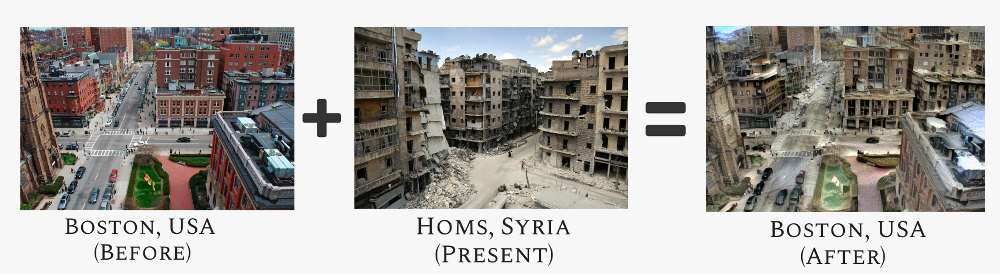
Deep Empathy Boston+Syria

«Can we use AI to increase empathy for victims of far-away disasters by making our homes appear similar to the homes of victims?»

Source : Deep Empathy

«Unsupervised image-to-image translation aims at learning a joint distribution of images in different domains by using images from the marginal distributions in individual domains. Since there exists an infinite set of joint distributions that can arrive the given marginal distributions, one could infer nothing about the joint distribution from the marginal distributions without additional assumptions».

Source : Unsupervised Image-to-Image Translation Networks | Research

« Older posts Newer posts »

© 2026 no-Flux

Theme by Anders NorenUp ↑