
Étiquette : big science (Page 1 of 2)

A new preprint server welcomes papers written and reviewed by AI

“At most scientific publications, papers co-authored by artificial intelligence (AI) are not welcome. At a new open platform called aiXiv, they are embraced. The platform goes all in on AI: It accepts both AI- and human-authored work, uses built-in AI reviewers for baseline quality screening, and guides authors through revisions based on the chatbots’ feedback. “AI-generated knowledge shouldn’t be treated differently,” says Guowei Huang, one of aiXiv’s creators and a Ph.D. candidate specializing in AI and business at the University of Manchester. “We should only care about quality—not who produced it.”The platform is still at an early stage; after a mid-November update, it hosts just a few dozen papers and early-stage proposals. But many researchers say it promises a welcome reprieve for the overloaded human peer-review system, which has been forced to shoulder the ongoing surge of papers driven by both legitimate and banned use of AI. “It’s extremely important that the automated science community take responsibility for how they are going to evaluate their own research,” says Thomas Dietterich, an emeritus professor of computer science at Oregon State University.”

Source : A new preprint server welcomes papers written and reviewed by AI | Science | AAAS
Giant, free index to world’s research papers released online

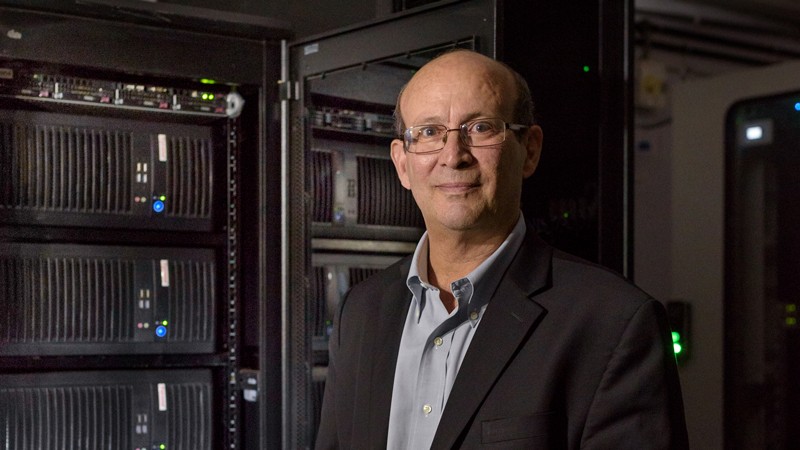
Carl Malamud

“In a project that could unlock the world’s research papers for easier computerized analysis, an American technologist has released online a gigantic index of the words and short phrases contained in more than 100 million journal articles — including many paywalled papers. The catalogue, which was released on 7 October and is free to use, holds tables of more than 355 billion words and sentence fragments listed next to the articles in which they appear. It is an effort to help scientists use software to glean insights from published work even if they have no legal access to the underlying papers, says its creator, Carl Malamud. He released the files under the auspices of Public Resource, a non-profit corporation in Sebastopol, California that he founded. ”

Source : Giant, free index to world’s research papers released online

A capuchin monkey sticks its tongue out, appearing to mock the superior cognitive flexibility of monkeys as compared to humans.

“When it comes to being willing to explore more efficient options to solving a problem, monkeys exhibit more cognitive flexibility than humans, according to a study by Georgia State University psychology researchers. “We are a unique species and have various ways in which we are exceptionally different from every other creature on the planet,” said Julia Watzek, a graduate student in psychology at Georgia State. “But we’re also sometimes really dumb. […] I think we’re less and less surprised when primates outsmart humans sometimes”.

Source : Monkeys Outperform Humans When It Comes To Cognitive Flexibility, Georgia State Study Finds – Georgia State University News – College of Arts and Sciences, Press Releases, Research, University Research

Facebook tarde à livrer les données promises aux scientifiques

“Facebook avait précisé que les données transmises aux scientifiques sélectionnés seraient anonymisées. Mais il est techniquement très compliqué de le faire totalement sur de vastes jeux de données personnelles. Par le biais de croisements et de recoupements, il est possible de réidentifier des internautes pourtant « anonymes », comme l’avaient montré, dès les années 2000, des recherches effectuées à partir d’une fuite de données issues du moteur de recherche d’AOL. Pour limiter ces risques, Facebook avait annoncé travailler à une anonymisation dite « différentielle » des jeux de données, censée régler le problème. C’est ce nouveau processus qui « a pris plus de temps que prévu », explique le réseau social.”

Source : Facebook tarde à livrer les données promises aux scientifiques

Le choix des Français ? Vraiment ?

“The Moral Machine Experiment, une étude réalisée par des chercheurs du MIT, a compilé les choix moraux de 2,3 millions de participants issus de 233 pays et territoires. Elle révèle qu’il n’y a pas vraiment de code moral universel, et que la France se distingue souvent de ses voisins.”

Source : Une voiture autonome doit-elle épargner l’enfant ou la personne âgée ? Découvrez le choix des Français – Tech – Numerama

“The team at Oak Ridge says Summit is the first supercomputer designed from the ground up to run AI applications, such as machine learning and neural networks. It has over 27,000 GPU chips from Nvidia, whose products have supercharged plenty of AI applications, and also includes some of IBM’s Power9 chips, which the company launched last year specifically for AI workloads. There’s also an ultrafast communications link for shipping data between these silicon workhorses.
Bob Picciano of IBM says all this allows Summit to run some applications up to 10 times faster than Titan while using only 50 percent more electrical power. Among the AI-related projects slated to run on the new supercomputer is one that will crunch through huge volumes of written reports and medical images to try to identify possible relationships between genes and cancer. Another will try to identify genetic traits that could predispose people to opioid addiction and other afflictions”.

Source : The world’s most powerful supercomputer is tailor made for the AI era – MIT Technology Review

« Older posts

© 2026 no-Flux

Theme by Anders NorenUp ↑