
We’re filing a lawsuit against the National Security Agency to protect the rights of the 500 million people who use Wikipedia every month.
Mois : avril 2015 (Page 6 of 7)
Unfortunately anonymity is just fundamentally incompatible with Javascript and the open web…

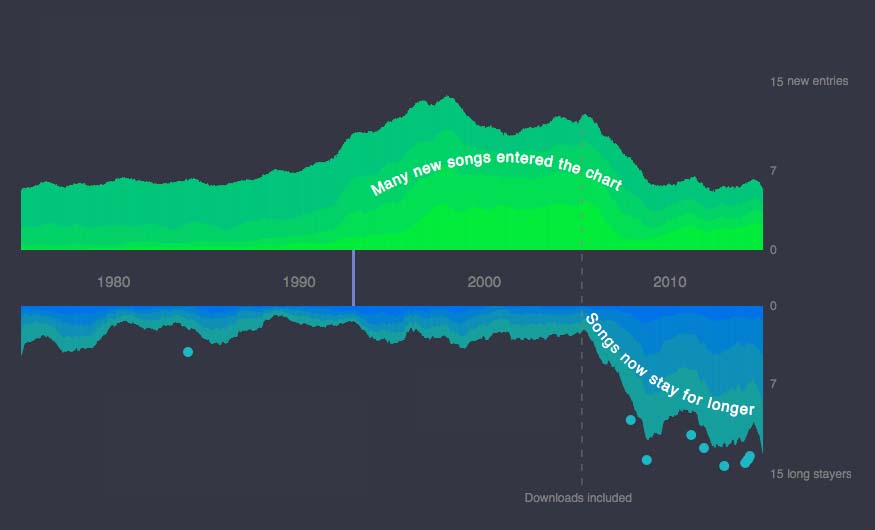
The average time that a single spent in the Top 40 in the 1990s and early 2000s was around four weeks. By contrast, by the end of 2014, singles were spending an average of eight weeks in the chart.
via Data visualisation: Top 40 turnover music – The Long and Short Season 3.
Le mal de mer est toujours présent ; il ne s’estompera qu’au bout de trois bonnes heures.
via On a testé pour vous… les jeux en réalité virtuelle de l’Oculus Rift.
L’Etat a financé nos recherches sur le contenu des sites consacrés aux troubles alimentaires mais n’utilise pas les résultats obtenus. Il semblerait que nos connaissances sur la question progressent, mais que l’inertie entre la publication des recherches et leur prise en compte par la sphère politique persiste.
via Interdiction des sites « pro-ana »: « une mesure inefficace et nuisible – L’Express.
But Parliament has a duty to protect citizens’ democratic rights from unduly expansive and intrusive government surveillance. French lawmakers should not approve the bill unless judges are given a proper role in authorizing government surveillance, vague definitions of what constitutes a terrorist threat are struck from the bill and freedom of the press is protected.
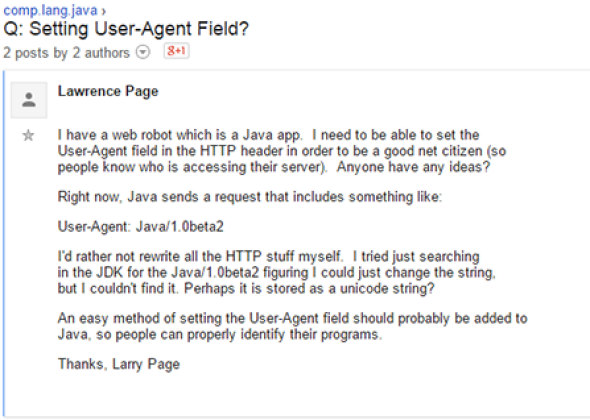
Alors qu’il était en train de développer Google, Larry Page a posé une question à propos de Java pour savoir comment régler l’user-agent pour son robot d’indexation.
The 160-page critique, which was supposed to remain private but was inadvertently disclosed in an open-records request, concluded that Google’s “conduct has resulted—and will result—in real harm to consumers and to innovation in the online search and advertising markets.”
For visitors that are not Facebook users, the cookie contains a unique identifier, and it has an expiration date of two years. Facebook users receive additional cookies that identify them uniquely. Once those cookies have been set, Facebook will receive them for every subsequent visit to a website that uses Facebook’s social widget. That applies whether or not the Facebook user is logged in to his or her account and whether or not the visitor to the third-party site actually uses the social widget.
via Report: Facebook tracks all visitors, even if you’re not a user and opted out | Ars Technica.